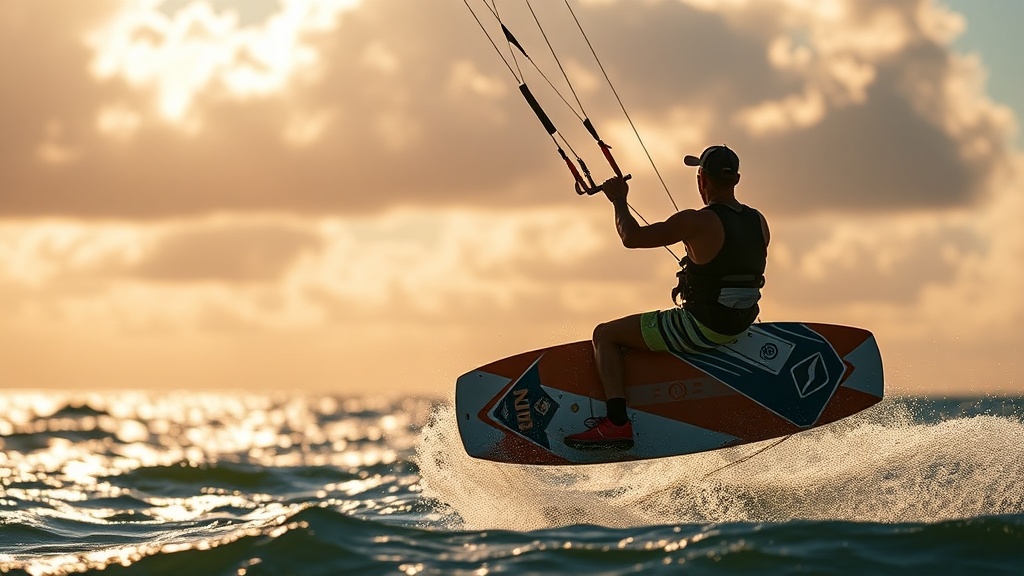
Why Strength Training Alone Won't Make You a Better Kiteboarder

The Myth of Gym-First Progression
Most riders assume that building bigger muscles translates directly to better kiteboarding. They spend winter months hammering out deadlifts and bench presses—only to hit the water in spring and discover their pop hasn't improved, their stamina fades just as fast, and their joints feel tighter than ever. Raw strength matters, but it's only one piece of a much larger puzzle. What separates riders who progress quickly from those who plateau isn't how much they can lift—it's how well their body adapts to the unique demands of wind-powered board sports. This post dismantles the "gym bro" approach and offers a smarter path forward.
What Muscle Groups Actually Drive Kiteboarding Performance?
The answer isn't what most people expect. While your core and legs get all the glory, your posterior chain, grip endurance, and rotational power do the heavy lifting. Your back muscles—particularly the lats and rhomboids—manage kite control through sheeting and steering. Your forearms and hands battle bar pressure for hours. And your obliques generate the twisting force that launches you off the water.
Here's where traditional programs fall short. A bodybuilding split targets muscles in isolation. Kiteboarding demands integration. You're not doing bicep curls on the water—you're absorbing impact, redirecting force, and maintaining tension through your entire kinetic chain simultaneously. That requires a different training stimulus entirely.
Focus on compound movements that mirror riding mechanics. Kettlebell swings develop hip extension for powered takeoffs. Pull-up variations build the specific pulling strength needed for bar control. And rotational medicine ball throws train your torso to generate torque—the exact movement pattern that separates stylish grabs from sloppy hops.
Why Is Mobility Work the Missing Link for Most Riders?
Stiff ankles kill your edge control. Tight hips prevent proper landing absorption. Restricted thoracic rotation limits your ability to spot landings and execute blind moves. Yet mobility training remains an afterthought for most kiters—if they address it at all.
The ocean punishes restricted movement patterns. When your joints can't move through full range of motion, your body compensates with poor form. That compensation breeds overuse injuries—Achilles irritation, knee pain, lower back tightness. Worse, it caps your technical ceiling. You can't style out a backroll if your spine won't rotate freely.
Dedicate fifteen minutes before each session to targeted mobility. Ankle circles, hip flexor stretches, and thoracic rotations pay dividends immediately. Your stance becomes more relaxed. Your board responds faster. And those awkward crash landings? They stop leaving you hobbling for days.
For evidence-based mobility protocols specific to board sports, check out EXOS's training methodology—they've worked extensively with action sports athletes on joint health and movement quality.
How Does On-Water Time Compare to Land-Based Training?
Here's an uncomfortable truth: thirty minutes of actual kiteboarding develops more sport-specific fitness than two hours in the gym. The stimulus of managing live wind, reading chop, and reacting to changing conditions creates adaptations that no land exercise can replicate. Your vestibular system sharpens. Your proprioception (your body's awareness of position in space) heightens. Your nervous system learns to fire efficiently under unpredictable load.
That doesn't make dryland training worthless—it means it should supplement, not replace, water time. The riders who improve fastest structure their training around maximizing sessions. Land work becomes preparation for the water, not a substitute. They use gym sessions to address weaknesses that limit their riding: building shoulder resilience to prevent impingement, developing ankle stability for rough conditions, or increasing work capacity so they don't gas out after forty minutes.
Think of it as training for the session, not just training to get strong. Every exercise should answer the question: "How does this help me ride better, longer, or safer?"
Why Do So Many Strong Riders Still Gas Out Early?
Cardiovascular fitness isn't glamorous, but it's the great equalizer. We've all watched muscular riders muscle their way through the first half hour—then spend the rest of the session floating, exhausted, missing set after set because their heart rate won't settle. Kiteboarding demands repeated high-output efforts with incomplete recovery. That's a specific energy system demand that steady-state cardio doesn't address adequately.
High-intensity interval training (HIIT) and sport-specific conditioning better prepare your physiology for the demands of a three-hour session. Think rowing sprints, battle rope intervals, or circuit training that keeps your heart rate elevated while your muscles work under tension. The goal isn't marathon endurance—it's the ability to explode, recover partially, then explode again. Repeatedly. For hours.
Your breathing matters too. Many riders hold their breath during maneuvers—a natural stress response that spikes blood pressure and accelerates fatigue. Practice controlled nasal breathing during your land training. Carry that respiratory awareness onto the water. Exhale during takeoffs. Breathe steadily during transitions. Simple? Yes. Effective? Absolutely.
Building a Training Week That Actually Transfers to the Water
So what does a smart approach look like? Prioritize movement quality first. Dedicate two to three sessions weekly to strength work that emphasizes control over load. Add two mobility-focused sessions—yoga, dynamic stretching, or targeted joint work. Then layer in conditioning: one longer aerobic session (thirty to forty-five minutes) plus one interval workout that mimics the stop-start nature of riding.
When you're actively kiteboarding, reduce gym volume. The water provides the primary stimulus; land training becomes maintenance and prehab. During off-season or flat spells, ramp up the dryland work—but keep it specific. Swap leg presses for single-leg Romanian deadlifts. Trade machine rows for suspension trainer pull variations that challenge stability. Every exercise should demand coordination, balance, or reactive strength.
For programming guidance from strength coaches who work with water sports athletes, the National Strength and Conditioning Association offers research-backed resources on developing power and durability for board sports.
Recovery: The Silent Performance Variable
You don't get stronger during training—you get stronger during recovery. That concept eludes many driven athletes who stack intense sessions back-to-back without adequate rest. Kiteboarding already beats up your connective tissue. Adding heavy lifting on top without proper recovery protocols accelerates wear and tear.
Sleep is non-negotiable. Seven to nine hours nightly. Your body repairs tissue, consolidates motor learning, and resets hormonal balance during deep sleep stages. Skimp here and your coordination suffers, your patience evaporates, and your injury risk climbs.
Nutrition supports the process. Adequate protein intake (roughly 0.7 to 1 gram per pound of bodyweight) provides the building blocks for tissue repair. Hydration matters—dehydrated tissue is prone to strain. And anti-inflammatory foods (fatty fish, berries, leafy greens) help manage the chronic low-level inflammation that accumulates from repeated water impact.
For practical nutrition strategies tailored to action sports athletes, Sports Dietitians Australia publishes excellent evidence-based guidance on fueling for intermittent high-intensity activities.
Putting It Together: The Smarter Path Forward
Ditch the bodybuilding mentality. Start viewing your training through the lens of movement quality, not muscle size. Ask whether each exercise helps you edge harder, jump higher, land softer, or ride longer. Build your mobility base. Train your energy systems specifically. And respect recovery as part of the process—not an afterthought.
The riders who last decades in this sport aren't the ones who lifted the heaviest. They're the ones who trained intelligently, moved well, and kept their bodies resilient enough to handle season after season of salt, wind, and impact. That takes discipline—but it's the kind of discipline that pays dividends every time you hit the water.