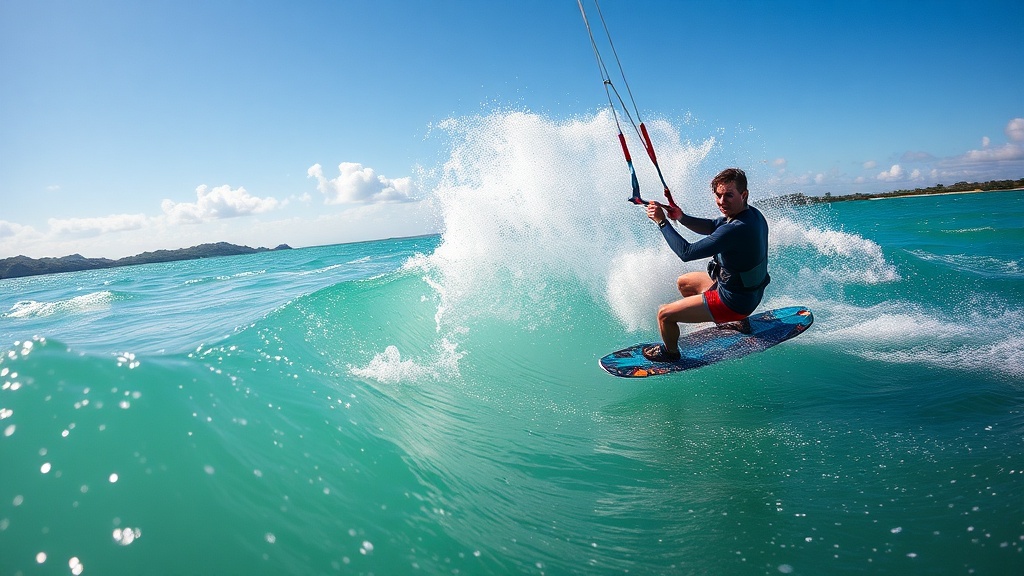
How to Master the Water Start in Kiteboarding

The water start separates those who simply fly kites from those who actually ride. This guide breaks down the exact technique for getting up on the board—covering kite positioning, body mechanics, board control, and common mistakes that keep beginners floundering. Master this skill, and the entire ocean becomes a playground.
What Is a Water Start in Kiteboarding?
A water start is the technique used to rise from floating in the water to standing on the board and riding. It's the bridge between kite control on land (or in the water) and actual board riding.
Here's the thing—most beginners struggle here far longer than necessary. Not because they lack athleticism, but because they treat the water start as a single motion rather than a sequence of coordinated steps. The kite pulls, the board digs in, and suddenly you're drinking saltwater again.
Breaking it down helps. The water start involves four distinct phases: positioning the kite at the correct launch angle, orienting the board perpendicular to the wind, extending the front leg while sheeting in, and then standing as the board planes across the surface. Miss one, and the whole sequence collapses.
How Do You Position the Kite for a Successful Water Start?
Start with the kite at the 12 o'clock position—directly overhead—while floating on your back with the board in front of you.
This neutral position matters. From here, you'll dive the kite toward the horizon in the direction you want to travel. Most beginners make the mistake of sending the kite too aggressively—whipping it from 12 to 3 (or 9) in one explosive motion. That generates power, sure. But it also yanks you face-first into the water.
The catch? You need progressive power. Dive the kite slowly at first—maybe to 1 o'clock if you're going right, or 11 o'clock if you're going left. Feel the tension build in the lines. As the kite begins to pull, then you sheet in (pull the bar toward you) to generate more lift.
Worth noting: kite position varies with wind strength. In light wind (12-15 knots), you'll need a deeper dive—perhaps to 2 or 10 o'clock—to generate enough pull. In strong wind (25+ knots), a small dip toward 11:30 is plenty. The International Kiteboarding Organization emphasizes this wind-aware approach in their certification programs.
Board position matters too. Keep it perpendicular to the wind direction—like a door swinging shut. If the board points downwind, the kite will simply drag you sideways without lifting you up.
What Body Position Should You Use During the Water Start?
Your body should form a compact crouch—knees pulled toward your chest, arms extended but not locked, eyes looking in the direction of travel.
This compact stance serves two purposes. First, it reduces drag in the water. The less surface area fighting against the pull, the easier it is to rise. Second, it pre-loads your legs for the standing motion that's coming.
Arm position trips up a lot of riders. Locked elbows mean you can't sheet in progressively—you're either fully powered or not at all. Bent elbows give you range. Keep the bar at chest height with soft elbows, ready to pull in as the kite generates power.
Head position is equally important. Look where you want to go—not at the kite, not at your feet. Your body follows your gaze. Staring at the kite pulls your shoulders back, which sinks your hips. Sunk hips equal failed water starts.
That said, beginners often forget about their back leg. It should stay slightly more bent than the front leg during the initial pull. This creates a sort of spring-loaded position. As the kite lifts you, extending that back leg helps push the board onto its planing surface.
Which Equipment Works Best for Learning Water Starts?
Gear choice absolutely affects how quickly you'll progress. Larger boards provide more flotation and stability—key for those first uncertain attempts. Smaller kites (relative to your weight) are more forgiving than overpowered setups that yank unpredictably.
Here's a comparison of board types suitable for mastering the water start:
| Board Type | Length | Best For | Water Start Difficulty |
|---|---|---|---|
| Beginner Twin-Tip | 140-150cm | First rides, light wind | Easiest—maximum stability |
| Freeride Twin-Tip | 135-145cm | Progression, all-around use | Moderate—more responsive |
| Surf/Directional | 5'6"-6'0" | Wave riding, strapless | Harder—requires different technique |
| Foil Board | 4'0"-5'0" | Light wind, advanced riding | Most difficult—minimal board contact |
For absolute beginners, brands like Cabrinha and Duotone offer excellent entry-level twin-tips. The Cabrinha Spectrum or Duotone Select are forgiving boards that won't fight you during those first water start attempts. Pair them with a kite sized appropriately for your weight—consult a kite size calculator if you're unsure.
Foot strap positioning deserves attention too. Set them wider than shoulder-width for stability. Angle them slightly outward—about 15 degrees—so your natural stance doesn't force the board edges to dig in prematurely.
Why Do Water Starts Fail—And How Do You Fix Them?
Most failed water starts stem from one of three errors: diving the kite too aggressively, standing up too early, or letting the board edge dig in before planing.
The "superman" faceplant happens when the kite pulls too hard, too fast. Your body goes horizontal, your feet slip out, and you're skimming across the surface on your stomach. Fix this by controlling the dive—smaller movements, progressive sheeting. Think coaxing, not commanding.
Standing too early kills momentum. Riders feel the pull and immediately try to jump to their feet. But the board isn't planing yet—it's still plowing through the water. Without horizontal speed, you sink. The solution? Stay low longer than feels natural. Let the board glide before extending those legs.
Edge dig-in occurs when the board's rail catches water during the initial pull. Instead of sliding onto the surface, it acts like a brake. This usually happens because the board isn't perpendicular to the wind, or because you're leaning back (pulling the edge in) instead of keeping weight centered.
Practice the "couch position"—sitting back as if in an invisible chair, board flat on the water, waiting for speed. Vancouver's Jericho Beach offers shallow, flat water ideal for drilling this. The consistent thermal winds and sandy bottom make it a favorite training ground for local instructors.
How Long Does It Take to Consistently Nail Water Starts?
Most riders achieve consistent water starts within 5-15 hours of water time—typically spread across 3-7 sessions.
This varies wildly based on prior board sport experience. Wakeboarders and surfers often pick it up faster because they understand edge control and weight distribution. Complete beginners to board sports face a steeper learning curve—not because the water start is complex, but because everything is new at once.
The real breakthrough usually comes suddenly. You'll struggle for hours, then something clicks—kite timing, body position, board angle—and suddenly you're riding. After that first successful start, consistency builds quickly. Each one reinforces the muscle memory.
Quality instruction accelerates this timeline significantly. A few hours with an IKO-certified instructor (available at schools like Squamish's Eco Marine) can shortcut days of frustration. They spot errors immediately—things you might not feel yourself doing wrong.
Drills to Speed Up Your Progress
Body dragging practice—using the kite to pull you through the water without the board—builds kite control confidence. Master upwind body dragging first. If you can't reliably return to your board without a board leash (which are actually discouraged for safety), you're not ready to combine kite and board control.
Beach starts offer another valuable drill. Sitting in shallow water with the board on, practice the kite dive and standing motion without the deep-water complications. Get the sequence smooth here, then take it to deeper water.
One-simulation drills work too. On shore, walk through the motions: kite overhead, dive and sheet in, crouch to stand. It looks silly. It works. Your brain builds the neural pathways without the water pressure.
What Comes After You've Mastered the Water Start?
Riding upwind is the natural next goal—and the skill that truly unlocks kiteboarding's freedom.
Without upwind ability, every session becomes a downwind drift followed by a long walk back up the beach. With it, you can explore, return to your starting point, and actually go places on the water.
The water start technique you've learned provides the foundation. The same kite control, the same body awareness, the same progressive power application—all apply when edging upwind. You're essentially doing a continuous, controlled water start in slow motion, maintaining the board's angle against the wind rather than riding straight downwind.
Stay patient during the learning phase. Celebrate those first wobbly rides—even if they only last seconds. The water start is kiteboarding's gateway skill. Once through it, the sport opens up in ways that keep riders coming back for decades.
Steps
- 1
Position your board perpendicular to the wind with knees bent and arms extended
- 2
Dive the kite firmly into the power zone while extending your front leg
- 3
Stand up gradually, shift weight to your back foot, and steer the kite upward